The morning QC is complete.
All three control levels have passed. HGB, RBC, WBC and PLT are within their assigned limits. The analyser shows no QC errors, and patient samples are ready to be processed.
Everything looks fine.
But what exactly have those QC results told us?
They suggest that the analytical system is performing acceptably under the conditions monitored by the control material.
They do not necessarily prove that every patient result will be accurate.
That distinction is where quality control becomes more than simply checking whether a number falls between two limits.
1. What Are We Actually Checking With QC?
Internal Quality Control (IQC) is designed to monitor the ongoing performance of a laboratory measurement procedure.
Instead of testing a patient specimen with an unknown result, we analyse a control material with an established target and expected distribution of results.
We then compare the measured value against the laboratory’s defined acceptance criteria.
If the results satisfy the applicable QC rules, the analytical run may be accepted according to the laboratory’s procedure. [1]
This gives us evidence that the measurement process is behaving as expected.
But QC does not measure every possible source of error.
Consider a routine haematology analyser.
Commercial control material may help monitor performance across parameters such as HGB, RBC, WBC and PLT.
It can reveal unexpected imprecision, substantial systematic changes or other analytical problems that affect the controls.
However, it cannot independently confirm that every patient specimen has been collected, stored, mixed and analysed correctly.
QC evaluates the measurement process under defined conditions. It does not verify every individual patient result.
This is why a passing QC result is important, but it is not the end of quality assurance.
2. Why Do We Run Different QC Levels?
Many haematology laboratories use control materials at low, normal and high levels.
The purpose is not simply to obtain three passing results.
Different concentrations may help reveal analytical problems that are not equally apparent across the measuring interval.
For example, an analyser might perform acceptably at a normal platelet concentration but show a larger error at a low concentration.
Monitoring different control levels can help identify concentration-dependent changes.
But there is an important limitation.
Three QC levels do not guarantee equivalent analytical performance across the entire patient measurement range.
A control labelled “low” may still be considerably higher than a clinically critical platelet concentration.
Similarly, a high-level control does not necessarily represent every extreme patient result encountered in practice.
The usefulness of each level depends on its concentration, the method’s performance characteristics and the clinical decisions being supported.
This raises another question.
If all three levels are acceptable, can we assume that the analyser is accurate?
Not quite.
3. Passing QC Is Not the Same as Proving Accuracy
Two concepts are frequently discussed in laboratory quality control:
Precision describes how closely repeated measurements agree.
Bias describes a systematic difference from an appropriate reference or target value.
QC helps monitor analytical variation, but its ability to demonstrate accuracy depends on how the targets were established and whether the control material adequately represents the intended measurement.
Consider an HGB control.
Suppose an appropriate reference target is 12.0 g/dL.
The analyser repeatedly produces results around 12.4 g/dL, with very little variation between measurements.
The results are tightly grouped.
That indicates good repeatability.
However, if the reference target is valid for this method and material, the measurements are consistently 0.4 g/dL higher than expected.
The method may therefore be precise while showing systematic bias.
Whether such results pass the laboratory’s QC rules depends on the established mean, control limits and statistical decision criteria. Properly established limits should detect a sufficiently large sustained deviation.
This example illustrates the difference between precision and bias; it is not an example of an automatically acceptable QC result.
The reverse situation is also possible.
An analyser may produce an average result close to the expected mean while showing excessive variation between measurements.
The mean looks acceptable, but the precision is poor.
A good QC programme needs to detect relevant changes in both random and systematic analytical performance. [1,2]
What about manufacturer-assigned targets?
Commercial controls usually come with manufacturer-provided target ranges.
These are useful starting points, but they should not automatically be treated as proof of the laboratory’s own analytical performance.
Where required, the laboratory should establish or verify its QC mean, SD and acceptance criteria using an appropriate procedure.
The underlying question is:
Are the control limits suitable for detecting errors that matter to our laboratory?
That question is more useful than simply asking whether the analyser displays PASS.
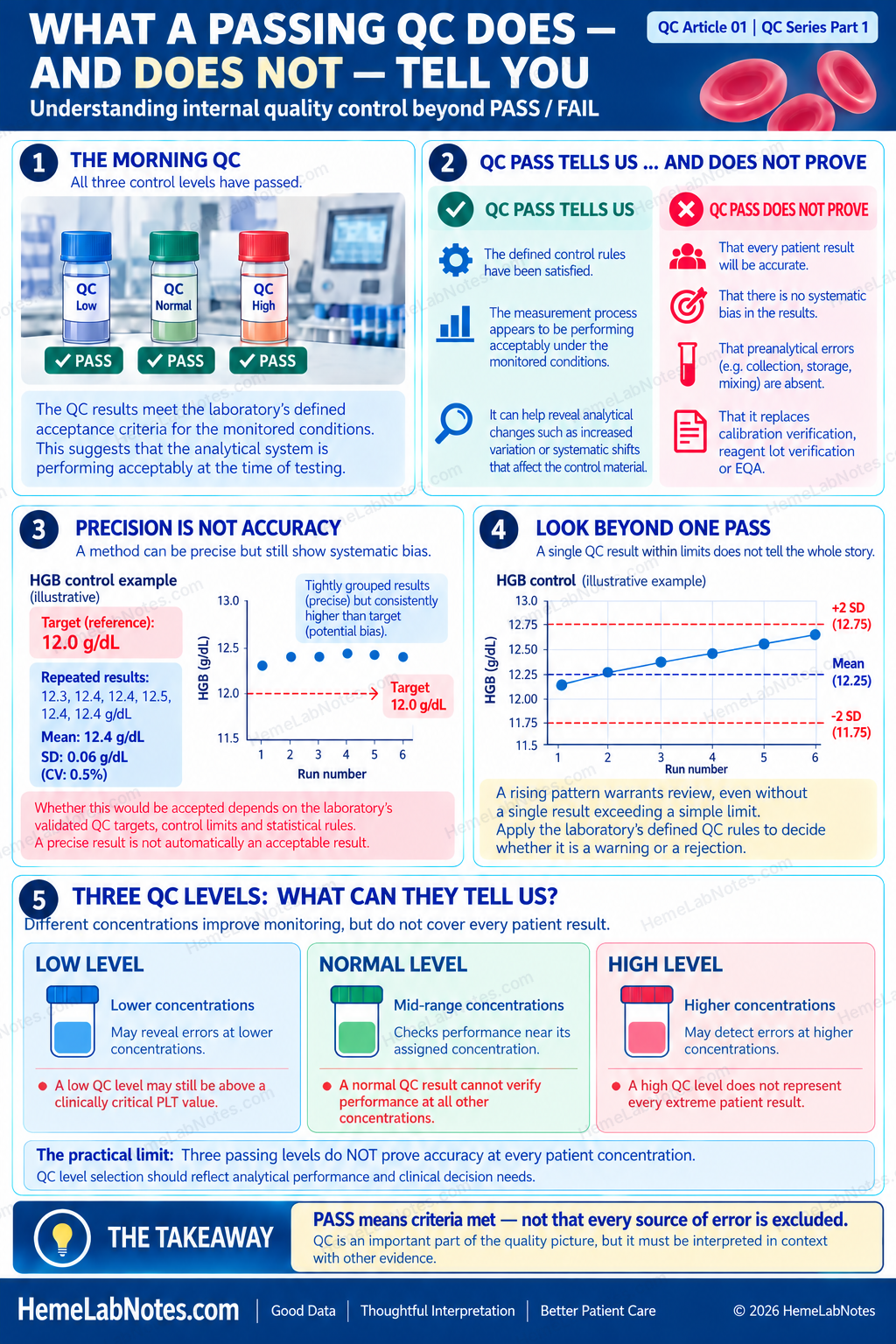
Figure 1. Passing QC provides useful analytical evidence, but precision, possible bias, longer-term patterns and control concentrations must also be considered.
View full size4. Can QC Pass While the Analytical System Is Changing?
Yes.
Imagine reviewing the HGB control results over several days.
Every result remains within the laboratory’s simple upper and lower control limits.
But the plotted results are gradually moving upwards.
At first, the changes are small.
The individual measurements do not look particularly concerning.
Then you notice that the recent results are consistently higher than those obtained earlier.
Has something changed?
Possibly.
A pattern like this deserves investigation, even if no individual result has exceeded a basic control limit.
However, we should not automatically call every upward movement analytical drift.
Normal random variation can also produce short sequences that appear directional.
Whether a pattern represents a QC warning, a rejection condition or an observation requiring continued monitoring depends on the laboratory’s established statistical rules and the evidence available.
This is why a Levey–Jennings chart can provide information that a simple PASS/FAIL indicator does not.
CLSI C24 emphasises the importance of appropriate statistical QC strategies and rules, while WHO guidance also recommends reviewing QC patterns over time to recognise potentially significant changes. [1,2]
A further distinction matters here.
A control result remaining within ±2 SD does not necessarily mean the complete QC run passes.
Other defined rules may identify a significant pattern even when individual results remain inside those limits.
We will explore the statistical meaning of these observations in later articles.
For now, the principle is straightforward:
Do not look only at the latest QC result. Look at what the recent results are doing.
5. Why Patient Samples May Behave Differently
Commercial QC materials are prepared to provide stable and reproducible measurements.
That stability is valuable.
But control materials do not always behave exactly like fresh patient blood.
Processed QC materials may have different properties from native patient specimens. Depending on the measurement procedure, those differences can affect how a control responds to an analytical change.
This concept is related to commutability — whether a processed material behaves like patient samples when measurement procedures are compared. [3]
The distinction becomes particularly important when evaluating changes in reagents or analytical methods.
A control material may show a change that is not representative of patient results.
Conversely, patient measurements may change without an equivalent response in the control material.
This does not mean commercial QC is unreliable or unsuitable.
It means QC must be used for the purpose it was designed and verified to support.
Why reagent lot verification needs patient samples
An apparently acceptable QC result after a reagent lot change does not necessarily establish that patient results remain comparable.
CLSI EP26 recommends a patient-sample-based approach to evaluating new reagent lots, with the aim of detecting clinically important differences between the current and candidate lots. [4]
This is important because processed control materials may not be commutable and may fail to reflect the effect of a reagent change on patient specimens.
Commercial QC and patient-sample lot verification therefore answer different questions.
One monitors ongoing analytical performance under defined conditions.
The other evaluates whether a change in reagent lot could produce an unacceptable difference in patient results.
Patient-based quality control in haematology
Haematology also has a long history of using patient results to supplement commercial QC.
Bull’s algorithm, commonly known as XB, was developed as an approach to deriving quality-control information from patient erythrocyte indices.
XB is a weighted moving average of patient MCV, MCH and MCHC, and it was later built into automated haematology analysers. [5]
The idea is to look for changes in the behaviour of a patient population rather than relying exclusively on processed control material.
However, patient-based monitoring has its own limitations.
Changes in patient mix, daily sample numbers, population characteristics or data selection may alter the monitored average even when the analyser remains stable.
These systems require appropriate design, baseline establishment and verification.
They complement commercial QC rather than automatically replacing it.
| Quality activity | Main question |
|---|---|
| Internal QC | Is the measurement procedure performing acceptably under the monitored conditions? |
| Calibration / calibration verification | Is the measurement relationship appropriately established or maintained? |
| Reagent lot verification | Does the new lot produce acceptably comparable patient results? |
| External Quality Assessment (EQA) | How does the laboratory perform against an appropriate external comparison or assessment? |
| Patient-based monitoring | Are patterns in patient results changing in a way that warrants investigation? |
These activities complement one another.
None should be treated as a universal substitute for the others.
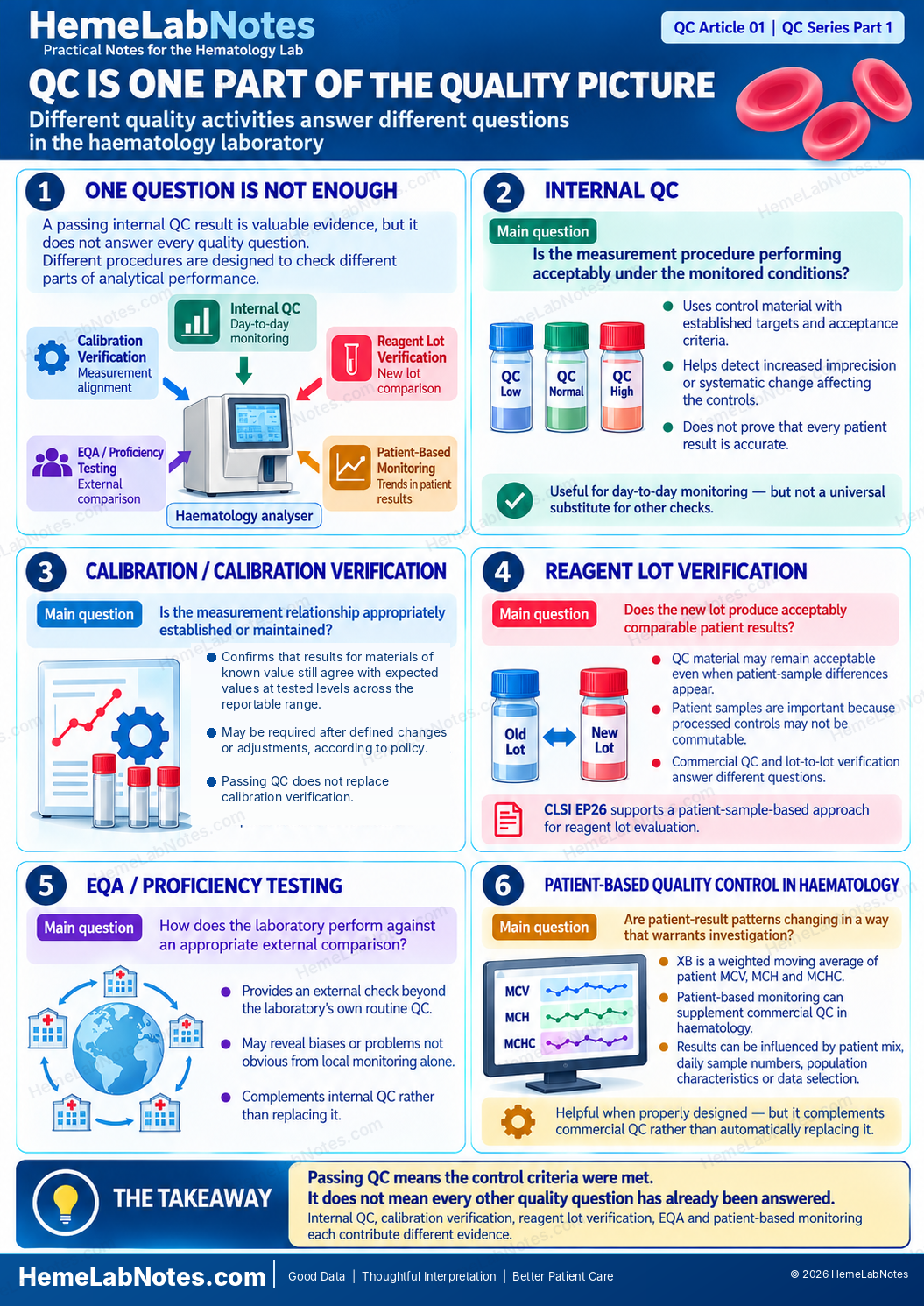
Figure 2. Different laboratory quality activities answer different questions and provide complementary evidence about analytical performance.
View full size6. What I Look For Beyond PASS or FAIL
When reviewing QC, I would want to understand more than whether the latest results fall within the accepted limits.
First — Are the results acceptable?
Review the applicable QC rules for the relevant parameters and control levels.
A QC failure needs appropriate investigation and corrective action before affected patient results are released, following the laboratory’s SOP. [6]
Repeatedly running the same control until a passing result appears is not an adequate substitute for investigating an unresolved problem.
Second — Are the results stable?
Look at recent QC history.
Are the results distributed around the established mean?
Has the variation increased?
Are several consecutive results moving in one direction?
Is a control level behaving differently from the others?
An unusual pattern does not always indicate analytical failure, but it should not be ignored simply because the current result is within range.
Third — Has anything changed?
Changes in analytical conditions may provide important context.
For example:
- A new reagent lot
- Calibration or instrument adjustment
- Maintenance or component replacement
- A new QC lot or target assignment
- Changes in control material handling or storage
An apparent QC change after one of these events may deserve closer investigation.
The aim is to determine whether the observation represents normal variation, a control-material effect or a change in analytical performance.
Fourth — Does the wider evidence agree?
QC is one part of the quality picture.
Patient-result patterns, instrument flags, previous results, method comparisons and external assessment findings may provide additional information.
When these observations disagree, I would investigate the discrepancy rather than assume that passing QC automatically resolves it.
A well-controlled analytical process is supported by several forms of evidence.
QC is one of the most important, but it is not the only one.
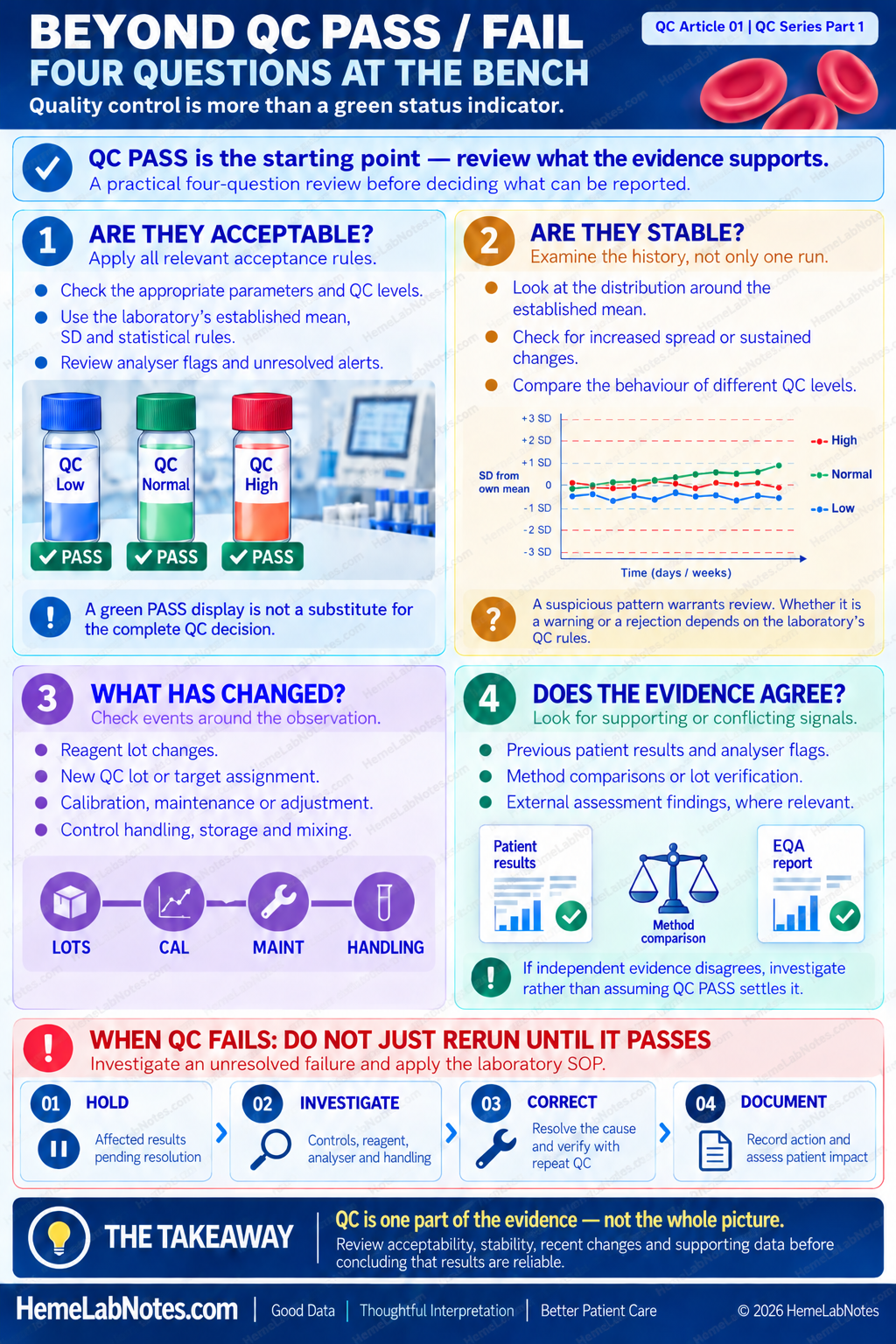
Figure 3. A practical bench approach to reviewing QC beyond PASS/FAIL and investigating results that do not satisfy established laboratory requirements.
View full sizeThe Takeaway
A passing QC result provides evidence that the analytical system meets its defined control criteria at the time of testing.
That is valuable information.
But it does not establish that every patient result is accurate, that the measurement process is free from all systematic error, or that no analytical change is developing.
Different control levels, appropriate target values, statistical rules and review of recent QC history all contribute to a stronger quality-control programme.
The important habit is to move beyond asking whether QC passed.
Start asking what the results are telling us about the measurement process.
A passing QC tells us the system has met the control criteria. Understanding QC tells us how much confidence we should place in that result.
Coming Next — QC Series Part 2
Understanding Mean, SD and CV: Reading QC Beyond the Numbers
Why does QC vary even when the analyser is performing normally?
What do Mean, Standard Deviation and Coefficient of Variation actually tell us?
And how can those statistics help us distinguish expected analytical variation from changes that deserve investigation?
These are the foundations we need before discussing QC Shift, Trend and Drift.
References
1. Clinical and Laboratory Standards Institute (CLSI). Statistical Quality Control for Quantitative Measurement Procedures: Principles and Definitions. 4th ed. CLSI guideline C24. Wayne, PA: CLSI; 2016.
https://clsi.org/shop/standards/c24/
2. World Health Organization. Laboratory Quality Management System: Handbook. Geneva: World Health Organization; 2011.
https://www.who.int/publications-detail-redirect/9789241548274
3. Clinical and Laboratory Standards Institute (CLSI). Evaluation of Commutability of Processed Samples. 4th ed. CLSI guideline EP14. Wayne, PA: CLSI; 2022.
https://clsi.org/shop/standards/ep14-plus/
4. Clinical and Laboratory Standards Institute (CLSI). User Evaluation of Acceptability of a Reagent Lot Change. 2nd ed. CLSI guideline EP26. Wayne, PA: CLSI; 2022.
https://clsi.org/shop/standards/ep26/
5. Bull BS, Elashoff RM, Heilbron DC, Couperus J. A study of various estimators for the derivation of quality control procedures from patient erythrocyte indices. American Journal of Clinical Pathology. 1974;61(4):473–481.
https://doi.org/10.1093/ajcp/61.4.473
6. World Health Organization. Laboratory Quality Stepwise Implementation Tool. Monitor and investigate failure of internal controls and improve accordingly.
HemeLabNotes provides practical educational material for laboratory professionals. Quality-control design, analytical acceptance criteria, troubleshooting and reporting decisions should follow the laboratory’s validated methods, applicable standards and clinical context.